Reveille Halloween Hunter

Quick, national version of the Halloween Hunter I just made for the Reveille. This one lets you use maps to find good spots for trick-or-treating in other states, and you can then choose to look at individual counties. Just click on the state or county map to change the view!

Jack-o-lanterns show zip codes with lots of households with kids.

Jack-o-lanterns show zip codes with lots of households with kids.

The Female Edge

The Female Edge

Republicans beware: The women are coming.

Turnout advantage/disadvantage for women since 1964. Red color shows an edge for women, blue an edge for men.

Turnout advantage/disadvantage for women since 1964. Red color shows an edge for women, blue an edge for men.

Given that women vote overwhelmingly democrat, trends in turnout among the genders have serious implications for the  balance of power between the parties.

Data analysis shows that women have gone from a 4 point turnout deficit in the 1964 presidential election to a 4 point advantage in 2012. This advantage shift is even more dramatic if you look at it as a relative difference between the genders — in that case, women started with a 6.82% deficit and now enjoy a 7.54% advantage — roughly a 14 point swing.

To quantify this advantage, a “female edge” figure has been computed. To do so, the turnout rate for women for each election is taken and divided by the turnout rate for men. This gives a relative difference between the genders, rather than what would be arrived at if one simply subtracted the male turnout percentage from the female turnout percentage.

Over time, a clear and distinct trend is visible, showing that women are now going to the polls at a higher rate for men, and that this trend is on a very consistent upward climb. As the years pass, women are coming to dominate turnout figures.

Pundits often discuss the threat posed to the Republican party by increasing numbers of Hispanic voters. This may be a very real danger, but it isn’t the only one the Republicans face. If they continue to lag heavily behind the Democratic party in popularity with women, the female edge means Republicans face an ever-more-difficult path to electoral victory, particularly in national elections.

Using the tool, more information can be examined. For instance, these trends become markedly worse if you break things down by age. The only group where men have a higher turnout rate than women is in the 65-and-over crowd. Given that this group is aging, and dying, and given that the female edge is even greater among the other age brackets, it’s difficult to view these numbers as anything other than great news for Democrats, and a looming danger for the GOP.

College Football Ranking Sentiment Map

Knowing where your team ranks each week is only half the battle – the other half is knowing *why* they ranked the way they did.

Map of rankings AP pollsters assigned Missouri, broken down by where pollsters live

Map of rankings AP pollsters assigned Missouri, broken down by where pollsters live

My new tool for the Reveille shows rankings, who voted for each team, and even puts together a national sentiment map to show where the voters live who love your team, as well as where on the map you’re not getting any love at all.

Here’s a link to my tool: http://public.tableausoftware.com/views/ReveilleWeek9APRankings-Narrow_0/DetailedAPCFBPollResults#1

Here’s the story on the Reveille: http://www.lsureveille.com/sports/football/interactive-see-where-ap-voters-ranked-lsu/article_af139c7c-39e2-11e3-82b4-001a4bcf6878.html

Not sure why my earlier post went away, but WordPress seems to enjoy doing that to me. Here’s hoping this post stays intact, so everyone can enjoy, share, and explore.

Oh – and be on the watch for a similar tool come basketball season!

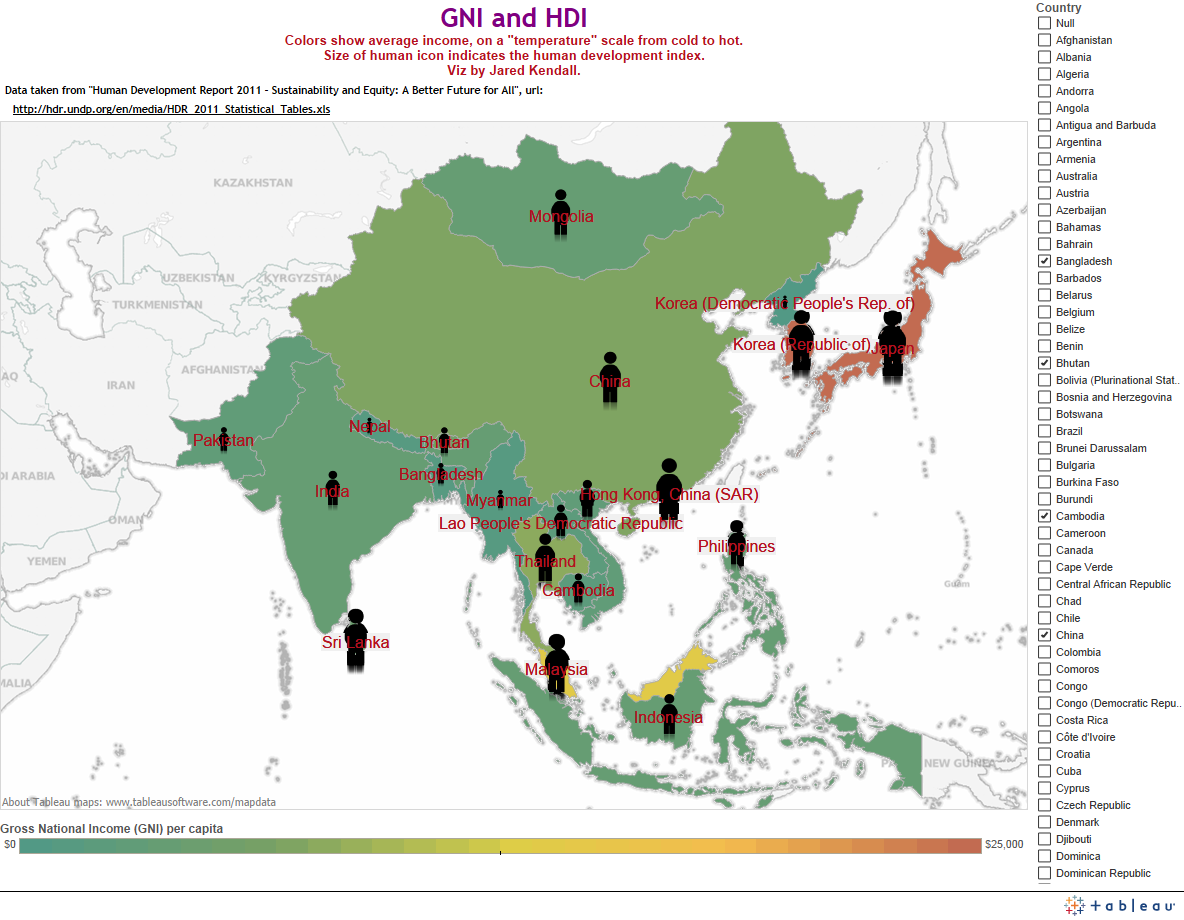
Poverty in Asia

GEOG1003I created several visualizations of gross national income (relative affluence of nations), shown by a “temperature” color scheme which runs from a cold aquamarine up to a hot brick red.

http://public.tableausoftware.com/views/GNIandHDI/GEOG1003?:embed=y&:display_count=no#1

The visualization also covers human development index, with human silhouettes. The size of the sillhouette indicates relative HDI for each country.


And, here’s a link to a global version of the map:


http://public.tableausoftware.com/views/GNIandHDI/GlobalGNIHDIMap?:embed=y&:display_count=no

I’m sure similar visualizations have been done before, but I believe this is a very effective way to present this particular data.


Enjoy!

Americans oppose the shutdown

Shutdown_PollIn a recent CBS survey, nearly three quarters of respondents said that they opposed the Federal government shutdown. The poll was taken just after the October 1st Federal shutdown, and the results used to build a Tableau visualization that makes it easier to look through the results of the poll in their entirety without resorting to perusing a text table.

http://public.tableausoftware.com/views/shutdownblame/ShutdownPoll?:embed=y&:display_count=no#1

For each question/topic raised by the poll, a a pie chart is provided showing the various responses, and the percentage of respondents replying each way.  If one then clicks on the percentage result, another breakdown is given, showing the demographic breakdown for that response.

Look for further polling visualizations as interesting poll data is released in accessible form.


Binders full of women… and Tableau.

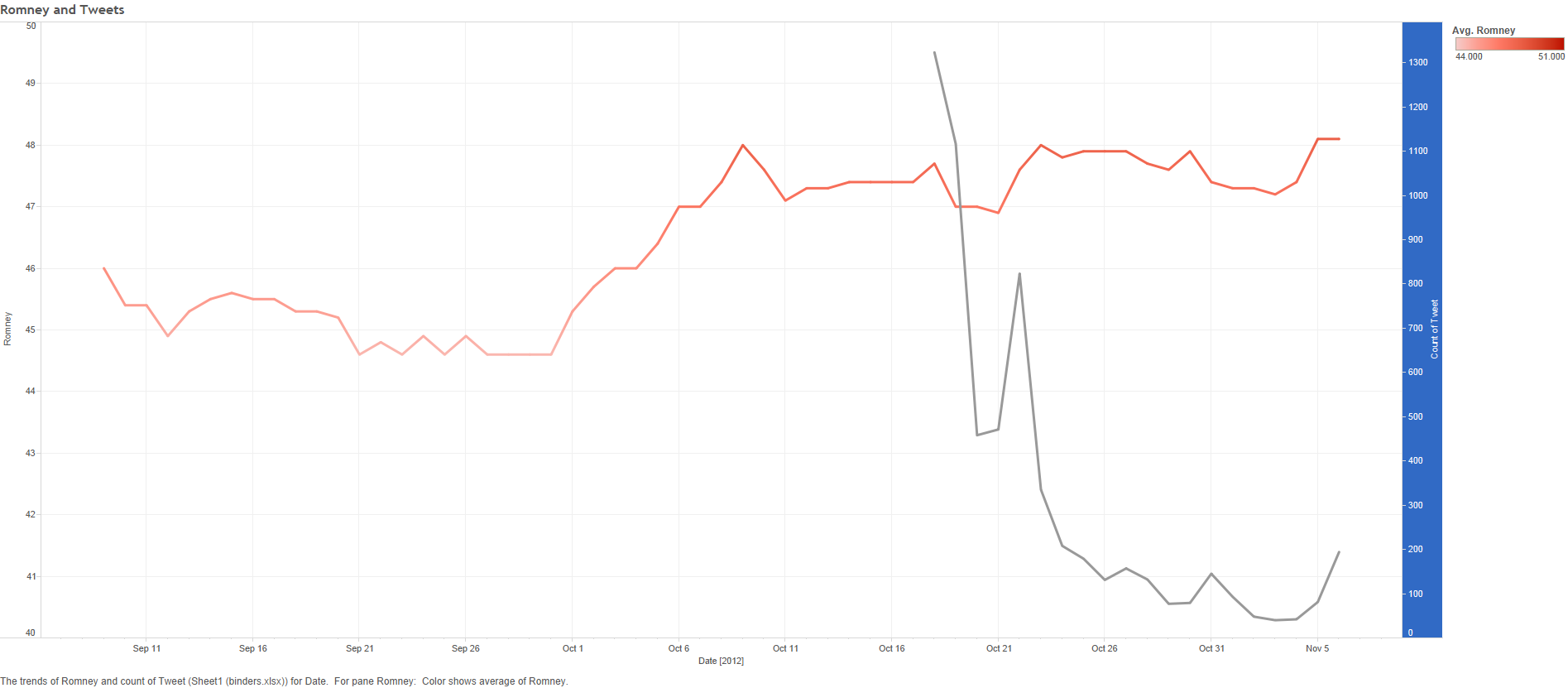
Romney and TweetsBinders full of Tableau

A quick Tableau looking at tweets with the #bindersfullofwomen hashtag following Romney’s debate gaffe turning into a viral meme.

I made this as part of a Storify piece on the binders uproar, you can see it here: http://storify.com/jwkendall/binders-full-of-women

I was pleasantly surprised by how easily I was able to put the poll and twitter data together was also quite proud of the fact that I got the twitter information myself – I didn’t use any third-party service. I actually simply held down the “page down” key on my keyboard for a solid half-hour from the main Twitter page. Perhaps forty five minutes. I retrieved around 10,000 tweets, and it didn’t appear my browser would’ve put up with my retrieving many more than that. This means the data can’t penetrate to that initial surge on the 16th or 17th, but frankly, the interesting data comes later, when we see the life cycle play out.

Using Tableau With Porn

Image

Data is beautiful, in that it doesn’t care about its surroundings. Data can be gathered by cloistered nuns, and it can be gathered by pornographers. Massive online porn destination, Pornhub, recently demonstrated this when it released an interactive showing the top three porn search terms, as well as the average length of stay, broken down by each state.

I will include a link to Pornhub’s viz, but first I’d like to put up a link to the “corrected” version I made. I found the original difficult to navigate when you wanted to see a particular state’s results. I fixed this by making the map a control feature. Now, when you click on a state, you only see that state’s information elsewhere on the page. Here’s the link:


http://public.tableausoftware.com/views/PH_avg-visit-durationredshtick/Dashboard1?:embed=y&:display_count=no


It defaults to Louisiana. Simply click on our state to see everyone, or click on another state if you’d just like to jump to their results.

I don’t anticipate working with pornography data again anytime soon. That being said, I would definitely like to get my hands on some of the raw figures involved. I’d just be sure and wash my hands really well after.

Here’s Pornhub’s original visualization, without my snazzy map cotrol:


http://public.tableausoftware.com/shared/HR9SZ66TW?:display_count=yes


And at the moment, they have it saved with a state selected. Not sure what’s up with that. But I applaud their use of the technology. I would love to see more corporations follow their lead. Internal data holds amazing stories – share them with the world!

What LSU spends on salaries

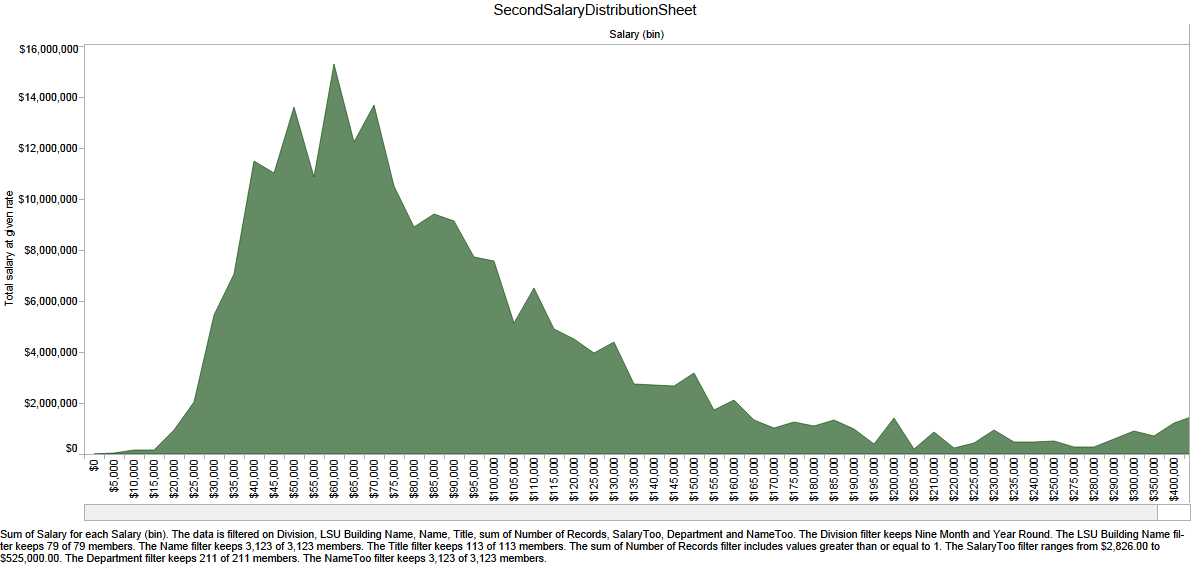
Tableau viz shows how much, total, was spent on salaries in each salary range.

Tableau viz shows how much, total, was spent on salaries in each salary range.

I love this one. It shows how much money, total, is spent to pay the salaries of LSU employees with salaries in a given range.

I’ll also include the link to the Tableau viz. It lets you play with switching between nine month and annual salaried employees. Nine month employees tend to be faculty, year round tend to be staff, but that’s only a very general rule of thumb.

http://public.tableausoftware.com/views/manualmap2test/SecondSalaryDistributionSheet?:embed=y&:display_count=no

As always, it’s the side stories I find fascinating with these projects.

Missing LSU Employee Addresses

Image

I love when a data project yields side information. In this case, while searching the LSU directory for employee contact information, I found that lower-salary employees were *much* more likely to be missing from the LSU online directory. Numbers are fun.

http://public.tableausoftware.com/views/manualmap2test/MissingAddressSimpleDash?:embed=y&:display_count=no